Actually, Finance is Really Important
Most people despise finance and finance people. And to be fair, there are many irredeemable finance folks. But if you spend enough time in certain circles (especially academic environments), you'll be met with a more pointed critique - "Finance is a waste of human capital." Otherwise very smart individuals will make this brand of pronouncement with no qualms, and truly believe it. To that person, I say:
- If you think finance is a waste of time, money, and human capital, you are wrong.
- If you think that finance is wholly comprised of zero sum games, you are wrong.
- If you think people in finance make too much money, you are wrong.
- If you think finance is a blight on humanity, you are wrong.
If you are wrong, that's okay, I forgive you, it's easy to be wrong. And on this particular point, the wrong view is also the consensus. Indeed, even most vest wearing IB bros and pantsuit private equity gals find themselves espousing many of these same (sorely mistaken) views.
This is because it is a fairly contrarian stance to argue that finance is actually an extremely important sector of the global economy and is directly responsible for a great deal of good. But it is.
Liquid capital markets are necessary for almost all innovation
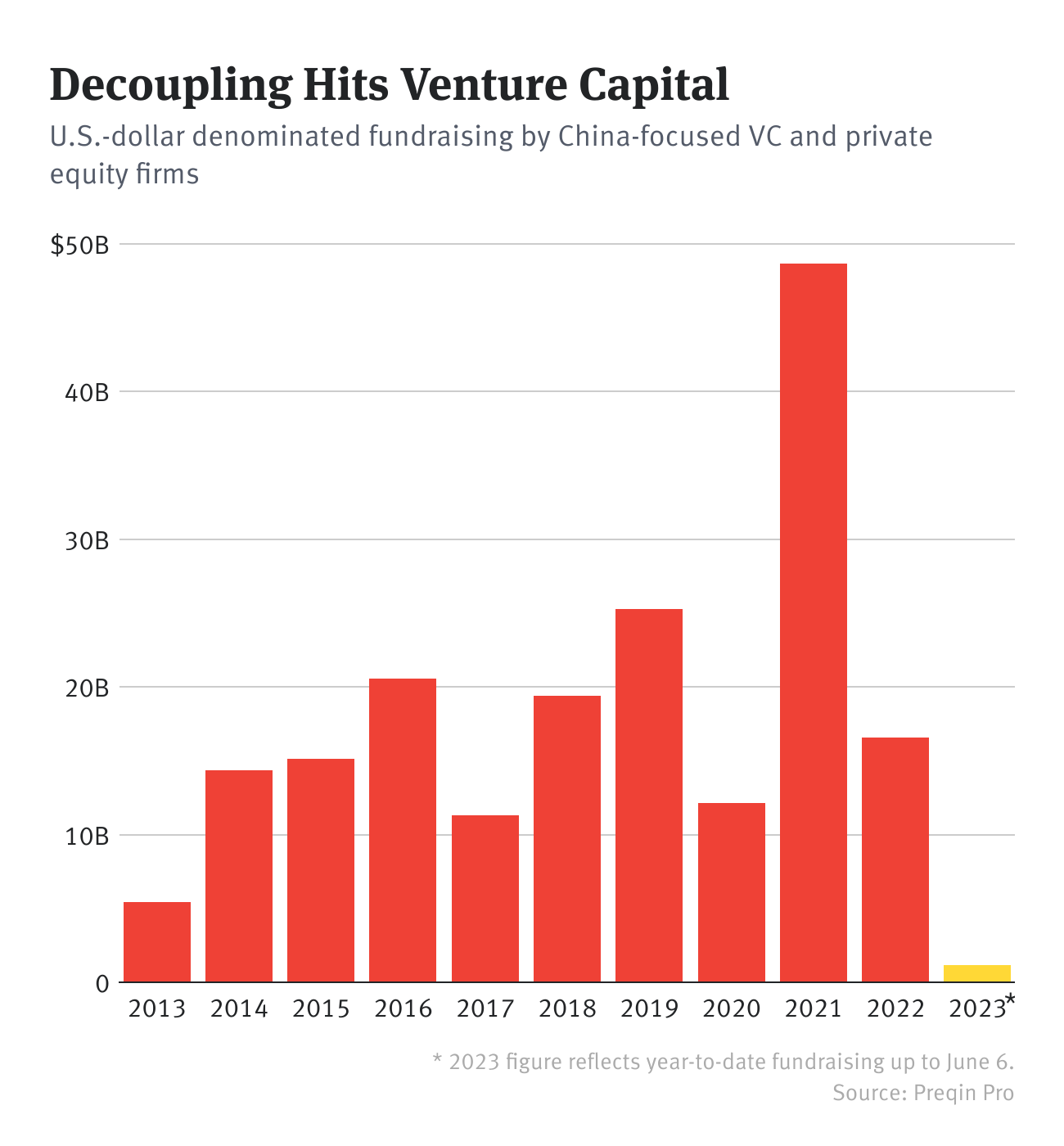
It should be obvious that innovation requires capital - starting a company, building a factory, hiring employees, etc. What is less obvious to some is the direct link between the capital that typically fills that role - VC - and the public markets. But without liquid public capital markets, VCs wouldn't exist. Where would VCs get their exits? Certainly not IPOs. Acquisitions by larger companies would also slow or cease as they too are heavily reliant on capital from public markets (debt offerings, paying for companies in the acquiring entity's shares, etc). Liquid capital markets are absolutely essential in incentivizing early and speculative investment in nascent innovation. One interesting example of this is China's domestic private capital markets, or stunning lack thereof. For a country with over 4 times the population of the US, Chinese venture capital and private equity are essentially nonexistent:
This is in stark contrast to US funds, which raise and deploy colossal sums:
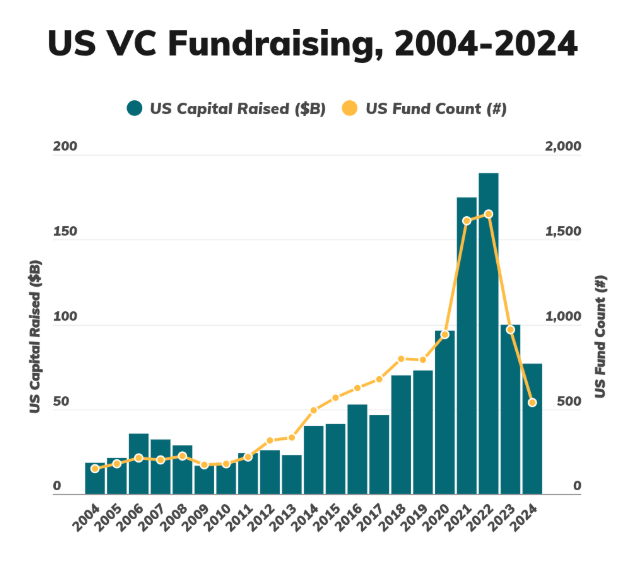
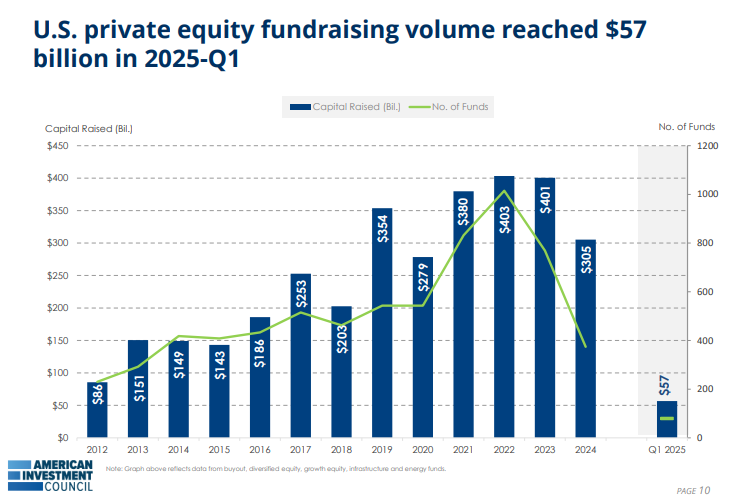
Sources for US VC fund numbers and US PE fund numbers.
The absence of venture and early stage funding crushes innovation and centralizes economic and political power in the hands of the establishment class. For the Chinese, this is the point - disruption and creative destruction are corrosive to the regime in Beijing. But the stifling impact that a complete absence of venture and private funding creates is felt everywhere. The most successful Chinese firms are just appropriated mirrors of their western counterparts (that were funded in almost all cases by US venture dollars, no less!). Groundbreaking, high risk innovation requires risk capital, risk capital that only dynamic and independent private investors like VC and PE firms can supply.
Principal agent problems are hard
Modern economies are mind-bogglingly complex. Take Apple for example. In theory, Apple is trying to accomplish a straightforward goal, the same goal as any other firm: maximize shareholder value. But Apple has over 7,000 institutional shareholders, and as of fiscal year 2024 over 164,000 employees. How do you align the interests of so many institutions and individuals? How do you stop executives from overcompensating themselves or their teams? How do you analyze the performance of a company making about $400bn in revenue?
The answer is that a lot of time, money, and smart human capital is poured into researching and analyzing all of these questions. Every facet of large companies is rigorously and constantly audited in search of unexplored angles or overlooked details. This is because modern capital markets reward insight handsomely. Even better, the more contrarian the insight, the greater the potential reward. The further a company is valued from its true worth, the more money that can be made in correcting it.
This is how principals (investors and capital) can be confident that the interests of their agents (the boards and CEOs and numerous employees) do not deviate too far from their own: the collective, open, churning wisdom of the market (and the many portfolio managers, traders, analysts, and activist investors) serves to keep firms honest and channels resources to the most productive ends.
Markets are an amazing communication & computation technology
Pricing things is an impossible task because the real world is irreducibly complex. So any system that has to account for the irreducible complexity of the real world needs to be dynamic, open, and constantly adjusting. What's more, it should also enlist as much computational power as is economically feasible. The best way to acquire this computational power is to push the computation to the edges, and be very sensitive to minor perturbations in the system. Free market economies do this very well: hedge funds pay millions for satellite images of Walmart parking lots to better approximate revenues in real time, for example. Prices cannot be set by edict: they become outdated the moment they're uttered. The constant feedback of an open market is the best method we have found to price things. And this is only possible if you have a sizeable sector of market makers, traders, and capital owners who are operating and monitoring the market.
Resources ought to be allocated towards the most productive pursuits
Allocating scarce resources to the most productive pursuits is the fundamental goal of the economy. But what constitutes the most productive pursuits? People value goods and services for all sorts of reasons after all. There's not exactly a single dimension upon which we can evaluate productivity/utility. The platonic ideal looks something like allocating scarce resources in such a way so as to provide the maximum possible utility to the maximum number of people. But inherent in that goal is the requirement that we somehow aggregate and account for the endless list preferences of every participant expresses.
Business, markets, and investors are constantly doing this. Markets reward participants who are good at allocation with yet more capital, which they can then can reallocate, creating a compounding feedback loop. And because of the nature of compounding returns, even allocating resources to a marginally more productive application will result in colossal out-performance over a long enough timescale.
Valid Critiques
There are plenty of valid critiques of finance, critiques that I deeply agree with:
- Finance is not sufficient for innovation and value creation. Moving money around between accounts, trading shares back and forth, writing checks to startups - none of these are sufficient on their own to innovation or value creation. Finance is only ever a partial causal factor in value creation. In many cases, finance may be necessary for said value creation. But it is basically never sufficient
- Finance often gets stuff wrong. Finance is hard - analysts and investors are always dealing with incomplete or incorrect information, fundamental assumptions are always shifting, and the government is constantly changing the rules. Incentives are difficult to get right within any firm, and in finance this is made especially hard because PnL are often far more transparent to employees than in other industries.
- When finance gets stuff wrong, it can have a large impact. Because the world of finance often serves as an interstitial web between disparate industries, reverberations of issues in one area of the financial world can felt far away. Also, the compounding nature of finance works in the negative direction: shorts get squeezed, bankruptcies cascade, funding dries up, liquidity evaporates. There are a ton of nonlinearities in finance.
- Finance can become rent seeking. This is especially (maybe primarily true) of subsections with heavy regulatory involvement. But then again, this is true of all industries, so it's not unique to finance.
- Finance is soft power. It's true that you can't stop tanks and bullets with liquid capital markets, at least not literally. But anyone with half a brain can see how robust capital markets enable a scale of production and a technical advantage that would otherwise be unobtainable. The more nuanced formulation of this critique is that an overly financialized economy will gradually decay and lose the ability to project hard power. I think there's a lot of truth in this critique, and I think we're seeing an active deconstruction of that particular aspect of over-financialization in the US today.
- Financial folks are often quite annoying. Yeah, what can I say. It's true. There's a certain brand of Machiavellian, narcissistic, master-of-the-universe person that Finance attracts, and these people are definitely insufferable.