World War Weird
Last Updated: 2025-08-11
Can you feel it? The winds are changing. Slumbering states are awakening from peaceful dreams into harsh reality. Land war in Europe. Military decapitations in Iran. The PLA leaks images of amphibious invasion landing barges being tested. Fighters shot down over Kashmir. Germany rearming. Tariffs and economic warfare abound. The heat is rising. The future is arriving. Are we prepared?
Are We Prepared?
To usefully answer this question, we have to first answer: for what? Determining the conflict that we need to prepare for is, obviously, the single most important question in gauging our preparedness. To this end, I believe there's only one plausible conflict in the next 10-20 years that will determine the future of the US, the West, and of mankind: a confrontation with the Chinese (likely beginning in the SCS/Taiwan). There's a couple reasons why I believe this is the most plausible and important conflict to prepare for:
-
Chinese demographics are collapsing. See below for Chinese population demographics. The next 10-20 years will mark the beginning of a coming cohort collapse in China as the consequences of the One Child policy and rapid modernization begin to reverberate through the economy. Total Fertility Rate in China is, like many other east asian countries, disastrously below replacement at 1.02. This means that the Chinese have a relatively narrow window of peak productivity and capability ahead of them before they go the way of Japan. Simulate it for yourself. Leadership might view this as existential, and see confrontation with the West as the only path back to long term growth.
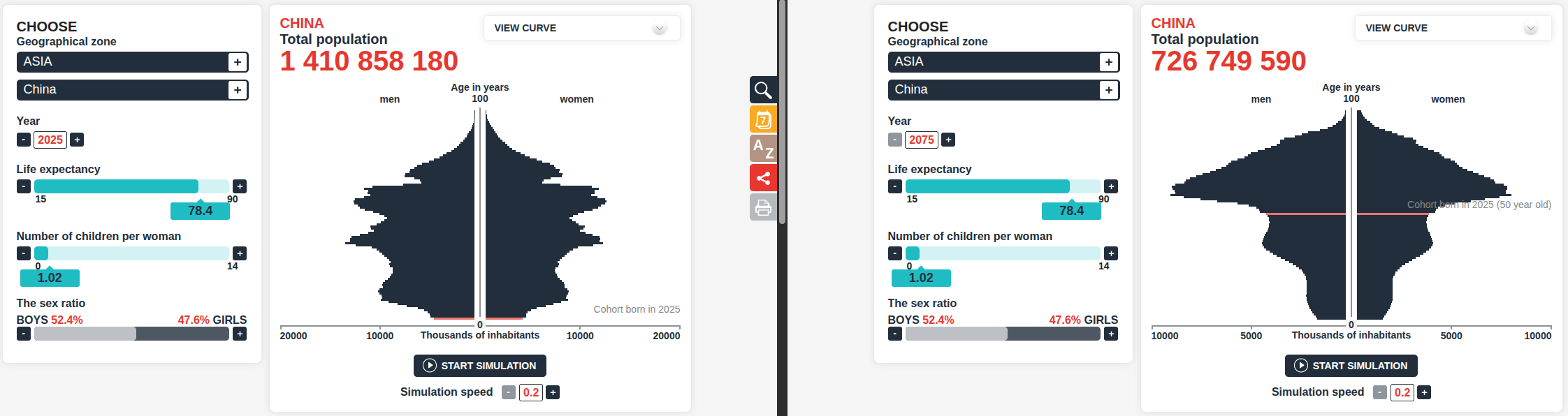
Chinese demographics, 2025 & 2075 -
Chinese GDP growth has slowed down. Many Chinese institutions are predicated on the assumption that growth rates will remain high, however they continue to slow (even according to Beijing's official figures). One interesting note here is how concentrated Chinese household wealth is in a single category - ~70% of Chinese household wealth is tied up in real estate. This is in stark contrast to the US and other developed western nations, where only around 27% of household wealth is in RE. Slowdowns in the Chinese real estate market began during covid, but have continued to today. What's more, it's now estimated that China will be unlikely to achieve parity with the US's GDP per capita figures. The rocket ship is running out of fuel, and some Chinese are beginning to feel the crunch. But a potential military conflict, especially a galvanizing nationalist cause like the liberation of Taiwan, might serve to reignite GDP growth (if only temporarily) and distract the Chinese populace from declining economic prospects.
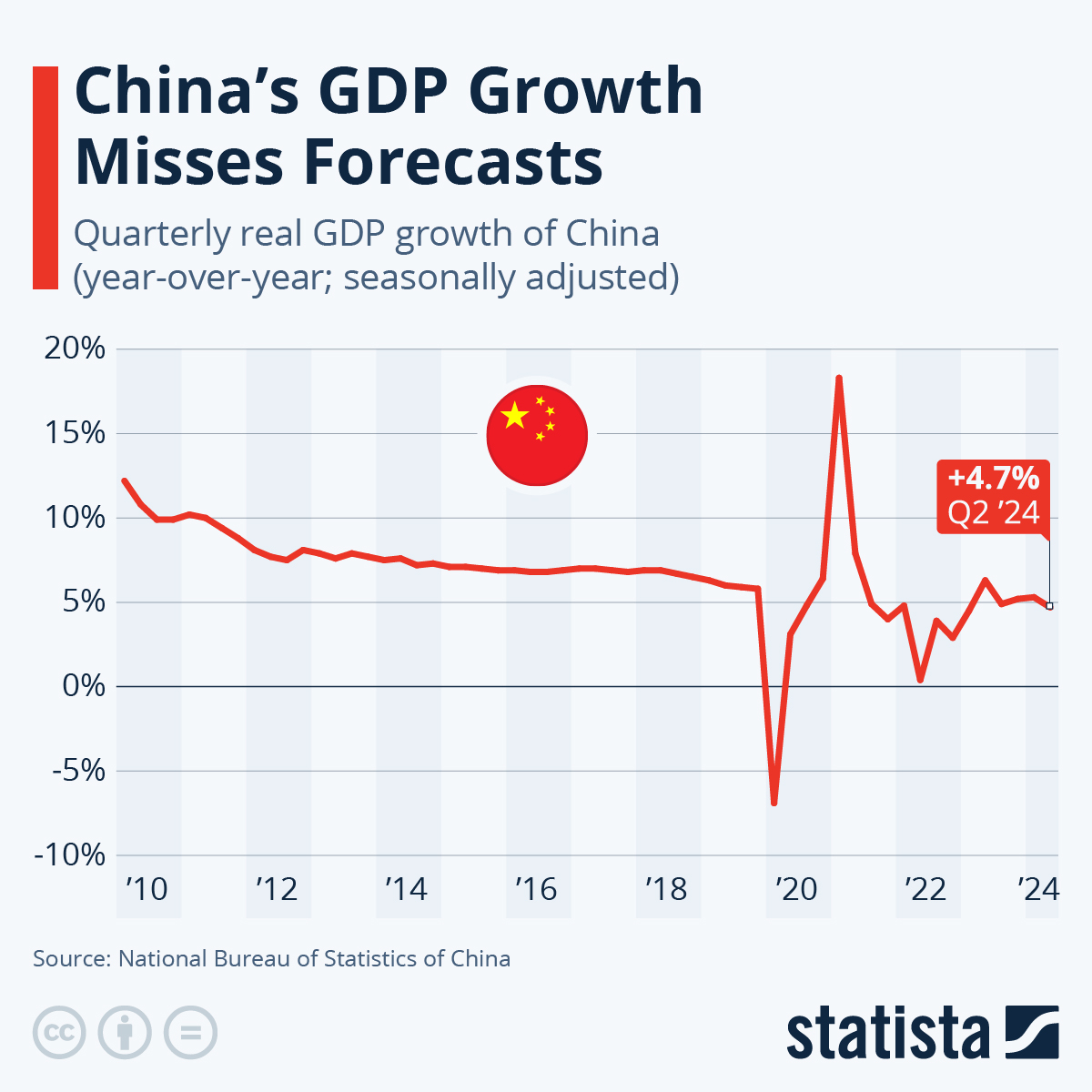
Chinese GDP Growth -
Xi is entering old age, and succession conflicts will begin soon. One hallmark of lasting authoritarian leadership is the elimination of suitable successors or alternatives. Xi has followed in the footsteps of those before him and ruthlessly purged the ranks of the CCP and the PLA of any possible challengers, and has never acknowledged the topic of succession. But age is inevitable, and every passing year brings Xi's death closer. At 72, it's possible Xi will remain healthy and vital for another two decades, but there is no guarantee, and as he enters the twilight years of his rule he will have to increasingly contend with enemies from within the party who would seek to capitalize on his advanced age and waning capabilities. In order to remain visibly and practically in control, Xi may feel forced to flex his military might and divert attention away from his old age and towards an external enemy. He may also seek to solidify his legacy by reuniting Taiwan with the mainland. Or he may view himself, in late age, as having nothing to lose.
-
Taiwan is moving away from reunification. For Beijing, this is a deeply concerning trend. Likely in part influenced by the rapid erosion of Hong Kong's independence, and by the CCP's draconian covid response, Taiwan has been shifting away from any possibility of democratic unification reliably for decades. This is especially true when you poll across age cohorts - younger Taiwanese are far more likely to support independence than older generations. We're still likely a decade or more away from any concerns of overt declarations of independence (ostensibly a red line for Beijing), however the derivative does not look good for the CCP, and implies that reunification will inevitably necessitate force.
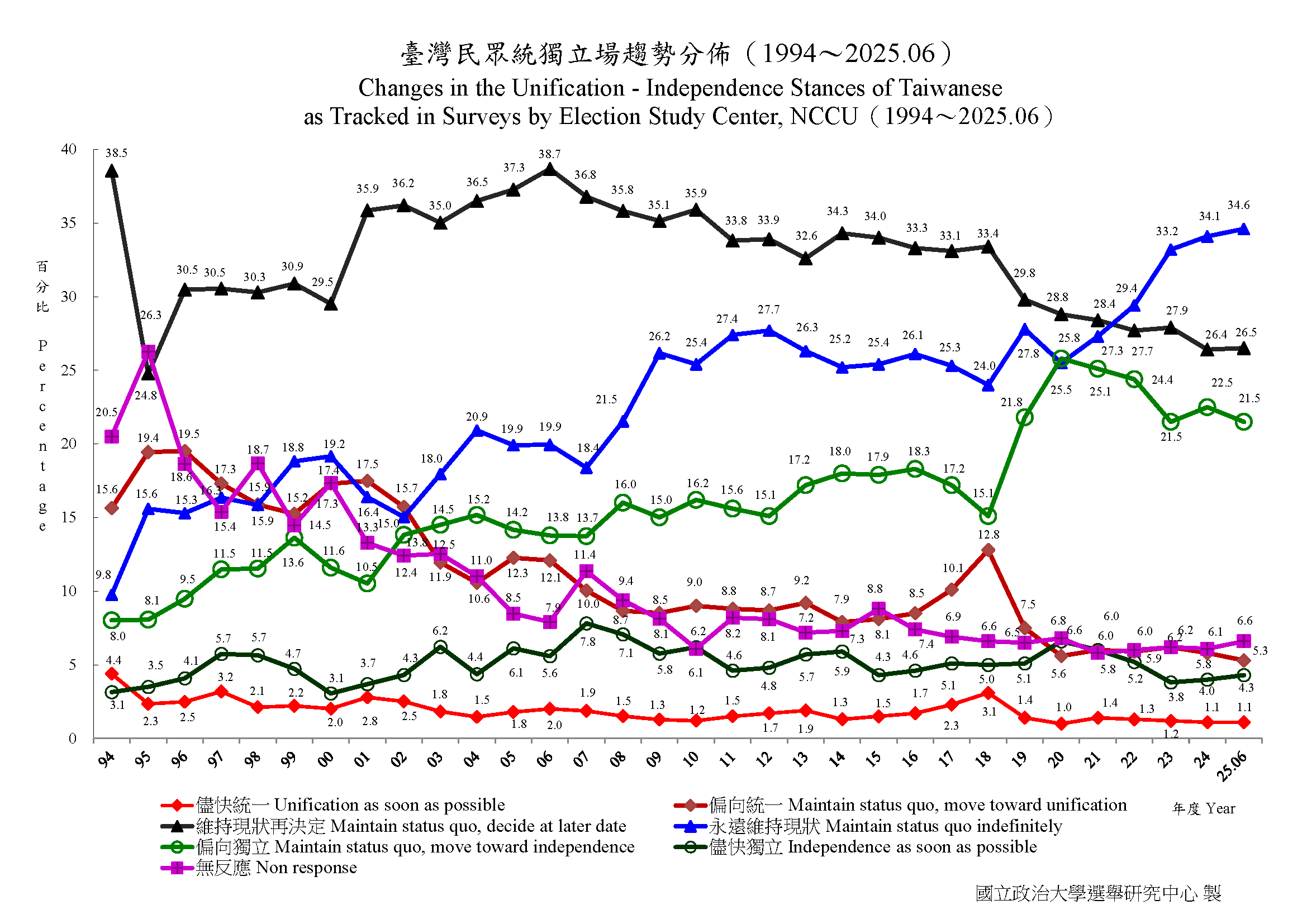
Independence stances of Taiwanese -
China is lagging behind the US in the race to AI. This, in my opinion, is the most important reason why we may see a conflict in the SCS, specifically over Taiwan. If the Xi and the CCP feel cornered by US progress and/or export restrictions/tariffs/sanctions, they may see an invasion of Taiwan as a bid for time. Invading Taiwan would entail the destruction of TSMC and other firms essential to the production of semiconductors, which in turn would likely substantially slow US progress, if only temporarily. That may be rational for the Chinese, depending on the state of their national semiconductor champions like SMIC and Huawei. This precise calculus may be related to the recent easing of export restrictions on NVIDIA's H20 - keeping China dependent on US designed semiconductors may slow their domestic development, thus raising the cost of a potential Taiwanese invasion.
Juxtapose a US-Chinese confrontation with any other feasible conflict, and consider which you find most plausible - Russia invades Poland? Another ground war in the Middle East? Which of these conflicts are we least prepared for? Which adversary is more formidable? It's painfully obvious that there is only one conflict we should be concerned about.
With this established, we can properly address the original question: are we prepared? Are we prepared to face the preeminent industrial and manufacturing superpower in a direct, head on conventional conflict? Are we capable of defending ourselves if attacked? Are we capable of defending Taiwan? Are we capable of taking out strategically important targets on the Chinese mainland if necessary? The answer to most of these questions is a resounding no. We're not prepared for this conflict when we would likely run out of anti-ship cruise missiles in as little as 3 days. We're not prepared for this conflict when we (and the rest of the world) import all of our rare earth metals from China. We're not prepared for this conflict when DJI, a single Chinese manufacturer, controls 90% of the global consumer drone market.
In short, no, we are not prepared. So what can we do in the intervening period to change that?
Our Objectives
Let's clearly define our objectives for a potential confrontation with China:
- Defend our critical domestic targets: nuclear response capabilities, continuity of civilian & military leadership, core infrastructure, and defense production capabilities.
- To be able to carry out (if necessary) limited conventional tactical strikes against targets deep in the Chinese mainland.
- Deter Chinese military or economic intervention in other neighboring allies like Japan and South Korea.
- Deter, or if that fails, defend against a Chinese invasion of Taiwan.
1. Defending Our Critical Domestic Targets
First, it must be said that the US is a geographically blessed superpower (and that the Monroe doctrine was and is based): In order to strike the US mainland with any conventional munition aside from an ICBM, the Chinese would have to position naval assets well within our direct reach (e.g. closer than Hawaii on the Pacific side). Therefore, besides the threat of submarine launched cruise missiles and ICBMs, the only options that the Chinese have to offensively strike domestic US targets is undercover sabotage teams on US soil. But as the Ukrainians and now Israelis have proven with recent drone strikes launched from behind enemy lines, this is not quite as far fetched as it might sound. A small team (1-4 people) could assemble and easily deploy substantial swarms of unmanned drones almost anywhere in the country. While we have spent decades building defensive capabilities to stop conventional strikes like those discussed above, we have almost no widely deployed capabilities for stopping such a domestically drone swarm attack.
2. Offensive Tactical Strikes on Mainland Chinese Targets
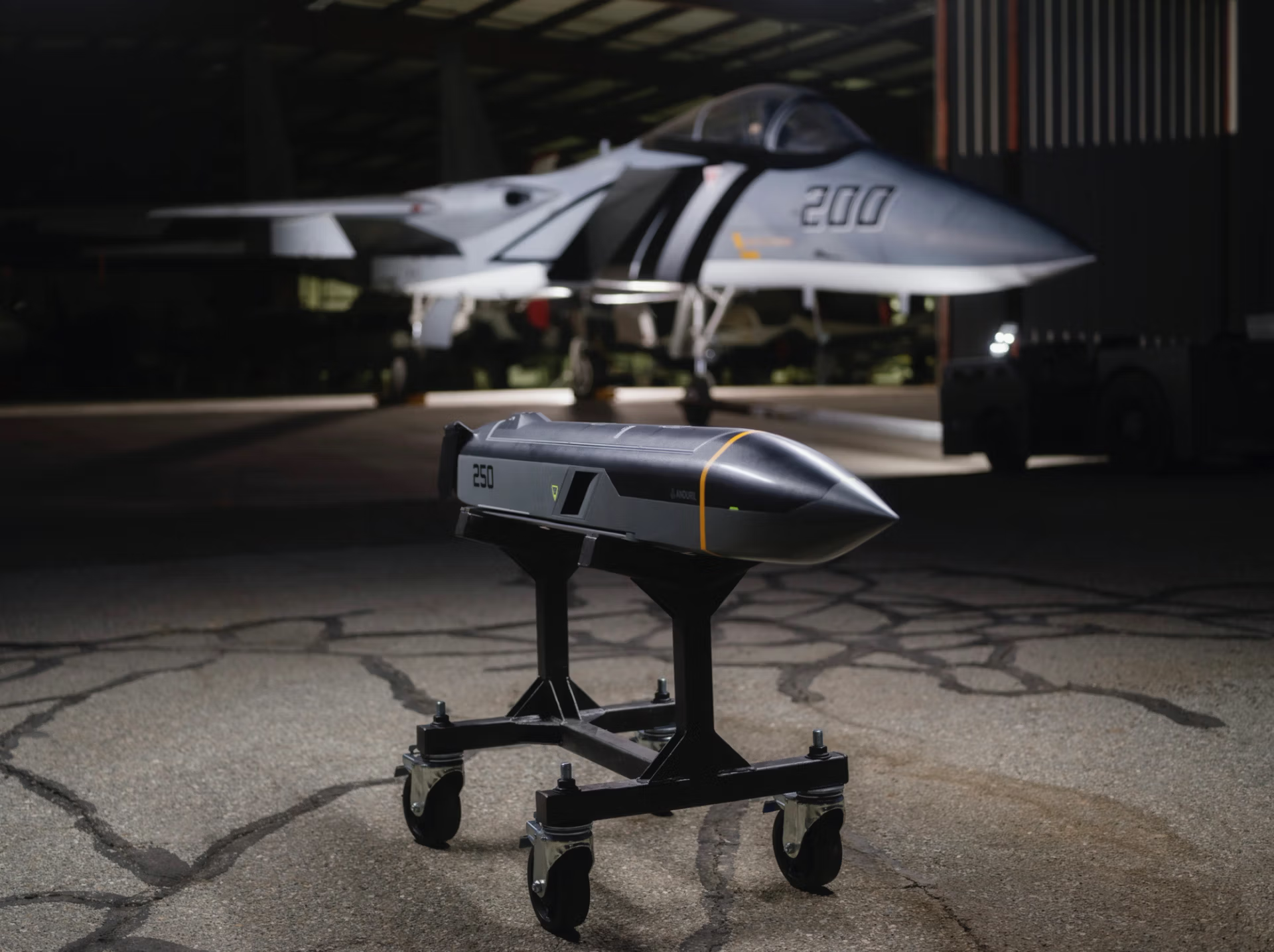
The US, as the preeminent expeditionary military force in the world, has a much wider array of options in striking targets on the Chinese mainland that vice versa: a single B2 taking off from Diego Garcia could deliver a payload of 16 AGMs to within striking range of targets as deep into the Chinese mainland as Xinjiang, and could likely do so without ever leaving international airspace. And yet, these platforms are extremely expensive and easily countered with standard static anti-air. To effectively strike targets in the mainland without resorting to ICBMs would require overwhelming defenses like these, and that is simply unachievable at current production scale and armament levels. We'll need to produce cruise missiles at a fraction of current costs: currently AGM-158C LRASMs (Long Range Anti-Ship Missile) cost $3.5m per unit, and AGM-158 JASSMs (Joint Air to Surface Standoff Missile) come in at $1.5-$2m per unit. It's these costs that heavily constrain inventory of these munitions - we may only have ~450 LRASMs total. The Pentagon is painfully aware of this, and the primes have begun to respond: Lockheed, L3 Harris, and Anduril all have announced programs with varying degrees of progress towards cruise missile systems with sticker costs as low as $150k per unit. Producing munitions at costs like these may serve to completely shift Beijing's calculus in the SCS.
As an aside, I should note that such a strike would only be justified in the most dire of circumstances. There is no clear line, from the Chinese perspective, between an incoming conventional AGM and one equipped with a tactical nuclear payload. As a result, any strike on the Chinese mainland would only be a superficial step removed from a full fledged nuclear strike (though, to be fair, this is the case for any strike against the mainland of a nuclear power). These are largely untested waters, and it may be possible that Beijing feels required to escalate as a result of such a strike. I'm merely arguing that we should have the capability, if required, to conventionally strike targets deep within the Chinese mainland in the event that it becomes necessary.
3. Deterring Chinese Military or Economic Intervention in SK & JP
While unlikely, it's not entirely infeasible that the Chinese might target Japan or South Korea in the event of an invasion on Taiwan, as many US assets and bases are hosted in these countries. A limited preemptive strike against these assets may be part of an initial battle plan. Further, if conflict escalates over Taiwan, China may feel strategically forced to cripple these assets and bases if they prove too troublesome. Defending these assets involves all of the considerations of the first point w.r.t. domestic drone sabotage, with the added difficulty of South Korea and Japan being well within the range of Chinese cruise missiles.
A more oblique tactic that the Chinese might be far more willing to engage in, both in the case of SK & JP, and especially in the case of Taiwan, is a naval blockade. Such a blockade, if allowed to continue for any extended period, would be catastrophic for continued US military support to the region. Taiwan, in particular, relies on imports of many key products (98% of Taiwan's energy supply is imported, for example), and would begin to suffer almost immediately. As a result, being able to break or otherwise circumvent a blockade is a necessary capability if the US is serious about defending our allies in the region.
4. Deterring or Defending from a Chinese Invasion of Taiwan
The remainder of this piece will address the shape of a potential conflict over Taiwan, the various technologies and competencies I view as most important to such a conflict, and what we need to do to win in the event of a Chinese invasion attempt.
The Future of Warfare (from First Principles)
IMHO there are 5 core principles that will determine the future of warfare, the efficacy of militaries, the usefulness of combat systems, and mankind's future by extension:
- Autonomy
- Expendability (AKA Attritability)
- Scale
- Decentralization
- Omnipresence
Every one of these principles or attributes is linked to every other, such that none can be fully accomplished or realized without all others. These attributes stand in stark contrast to those that I would use to describe our existing strengths, namely:
- Precision
- Projection
- Concentration
Autonomy
Autonomy is not, as some might believe, an unmitigated good: Competent human operators outperform autonomous systems in all but the most narrow applications, and I suspect that will remain true until we have much stronger AI. Autonomy is, however, absolutely necessary for certain applications, and what I'll argue is that the future of war will be dominated by such cases.
The first case relates to the second principle, Expendability: at risk of stating the obvious, for a human piloted machine to be expendable, the human cannot be inside. This means that all such systems require external communication links, links which can be severed by various electronic and physical interference methods. While these links can be severed, its much harder/more costly to completely destroy the entire system in most cases. If the system can survive and continue autonomously, even for a relatively short period, connection can often be resumed or the mission can be carried out to completion. Take, for example, drones on the Ukrainian front line: often these drones are jammed as they near their target. If they had onboard autonomy (and some do already) to either continue the last mile to their target or retreat out of range of the opponent's jamming capabilities, their efficacy can be improved immensely.
The second case relates to the third principle, Scale. A single drone can be shot down or avoided. A hundred drones cannot be. But a single pilot cannot provide granular flight inputs to a hundred drones simultaneously. Coordinating and controlling many assets in parallel will require each individual system to autonomously manage all low level concerns like flight controls, pathfinding, and collision avoidance. It may even require these systems to autonomously manage more abstract tasks like predicting opponent positioning from incomplete information or determining optimal formations in coordination with other friendly systems. In short, the number of unmanned assets on the battlefield scales up, coordinating those assets will necessitate autonomy.
Expendability
The last two decades of US military engagements have relied heavily upon exquisite systems. But these systems will not survive contact with the future: if a $13 billion dollar aircraft carrier can be crippled by 50x cruise missiles at $150 thousand a piece, that aircraft carrier is now an overpriced bathtub. The F-22's air superiority is predicated on its ability to outmaneuver and outshoot its opponents - but what happens when there's more opponents that it has rounds, and those opponents aren't even aiming for it, but instead the military base that it's protecting? Low cost, expendable systems introduce colossal asymmetry to the battlefield. This is an area where the US is uniquely weak: our military acquisition framework has been configured to reward exquisite, high cost, low quantity programs that have long shelf lives to amortize R&D costs over. Shifting doctrine in this dimension will be difficult and require immense effort.
Scale
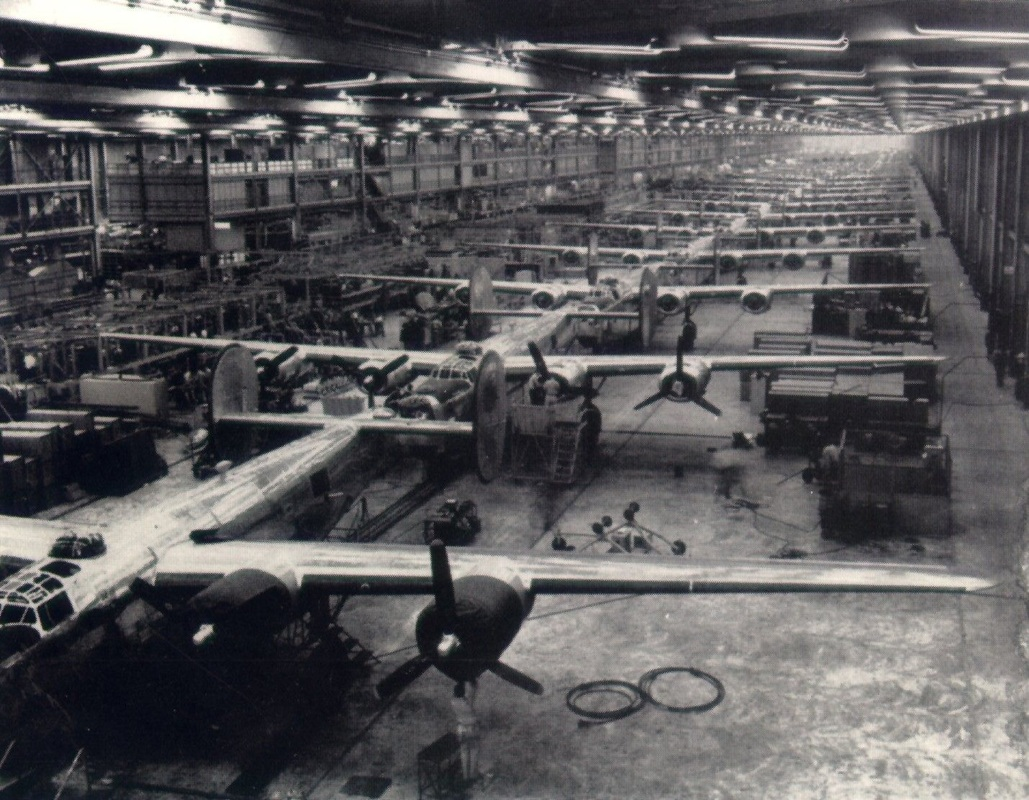
A system is only as expendable as it is easy to replace. And as highlighted in previous examples, overwhelming defenses with sheer quantity is one of the essential advantages of cheap autonomous systems. As a result, production scale will need to be colossal. This future conflict, moreso than any other previous large scale conflict, will begin to resemble a purely economic engagement (which, with the largest economy in the world, the US should ultimately embrace). Military results will be downstream of domestic production capabilities.
Scale in deployment will matter as well. Militaries will coordinate thousands or tens of thousands of systems to achieve tactical objectives. Long term success will be determined by combat efficiency and asymmetry in assets expended vs targets destroyed. To be competitive in this domain, the US will have to onshore or nearshore many capabilities that it currently outsources to China & Taiwan. The US has much work to do in this domain, and it's likely the greatest challenge we face - how do we onshore manufacturing quickly enough, without paying a huge economic cost, to be relevant in this coming conflict?
Decentralization
Decentralization is made possible through all these other attributes, and makes systems far more robust. By eliminating the need for a central node, you deprive the enemy of a target of outsized importance, and require them to deal with each and every element of your force individually. If a drone swarm is fully networked, it becomes exponentially more difficult to jam them. If cruise missiles are launched from many scattered unmanned drone ships as opposed to a single destroyer, your opponent is robbed of the opportunity to concentrate their assault on a single target. Furthermore, it forces your opponent to operate on your terms: many economical or efficient countermeasures are predicated on centralized threats. By decentralizing your force, you force your opponent to follow suit.
Omnipresence
If you have a ton of low cost, easily deployed, networked systems, you can be omnipresent in a way that is otherwise unachievable: imagine cheap passive senor buoys dotting the Taiwan strait, providing early warning and precise position of any amphibious assault. Imagine loitering munitions and ISR drones which, on their own, are cheap and expendable, but stitched together into a network provide a crystal clear, decentralized, and constantly updating picture of the battlefield. Imagine static cruise missile launch systems that sit quietly for years only to spring to life when called into action. There is an aspect in which the US military is already omnipresent: as the greatest expeditionary force in the world, we can get involved in any conflict, anywhere. However true omnipresence is a step beyond just the ability - it's the reality of being everywhere, already. This is only possible if you have numerous remotely controlled and autonomous systems that are already cheaply deployed all over the world.
To Be Continued
The purpose of this piece was to lay out the high level principles which I believe will be important in the future of warfare, and the coming conflict in Taiwan. I intend to write a followup that will dive into details about what roles and characteristics specific systems ought to fill/have, and where the US ought to invest to maximally prepare for a future conflict.